
 EN
EN

Direct answer: Self-locking in a worm gearbox is controlled by two independent factors. Speed ratio is the on/off switch — too low a ratio and self-locking does not exist regardless of materials. Worm wheel material is the strength dial — once the speed ratio threshold is met, material friction properties determine how reliably the gearbox resists reverse drive. Selecting one without considering the other leads to unreliable or absent self-locking.
The Physics Behind Self-Locking: Helix Angle vs. Friction Angle
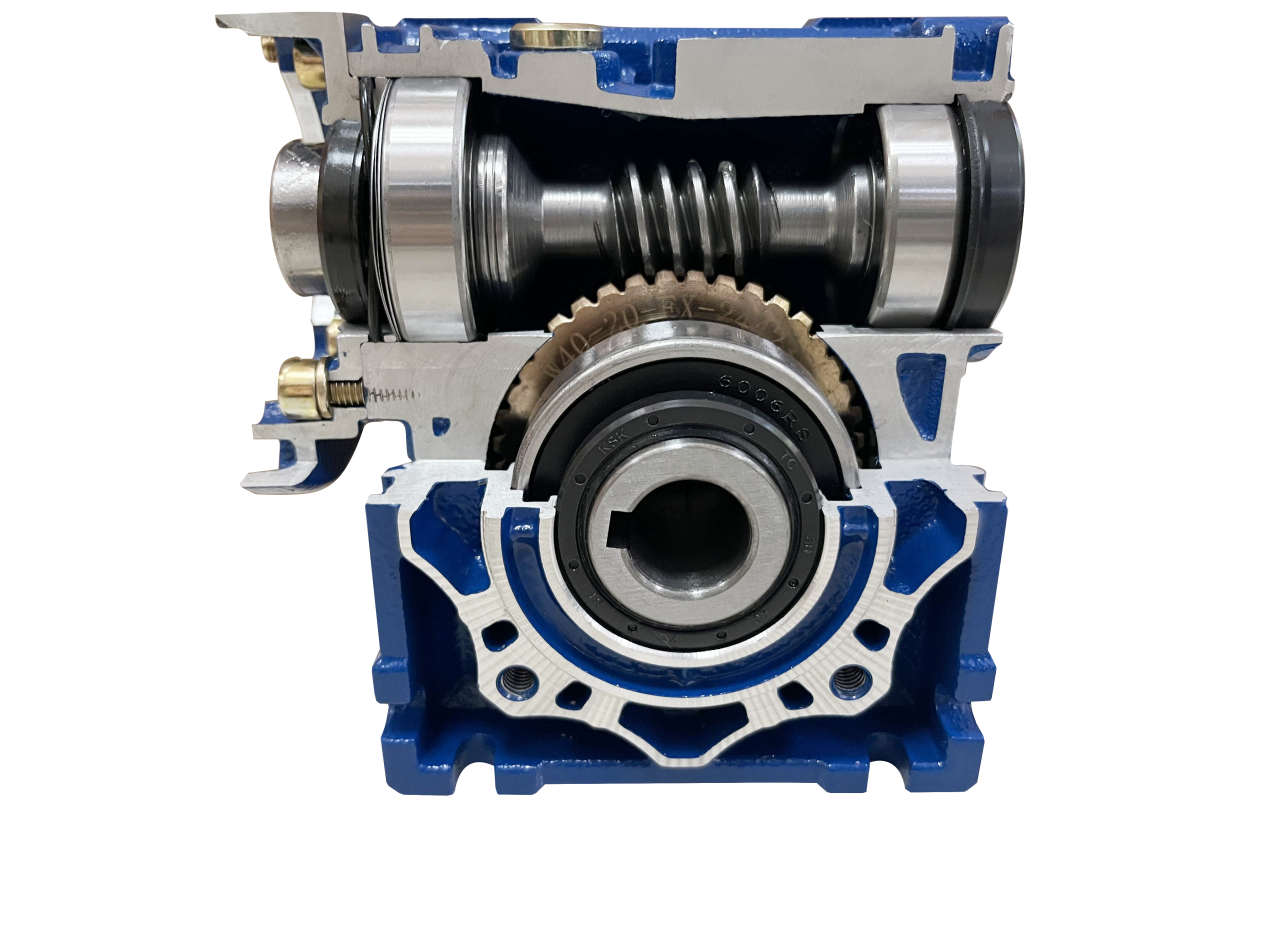
Self-locking in a worm gearbox occurs when the worm's helix angle is smaller than the equivalent friction angle of the tooth surface material pair. When this condition is met, any force applied at the output shaft cannot generate enough axial push on the worm to overcome static friction — reverse rotation is physically blocked.
Two geometric quantities govern this relationship:
- Helix angle — set by the number of worm thread starts and the worm module. It is inversely linked to speed ratio: the higher the speed ratio, the smaller the helix angle.
- Equivalent friction angle — derived from the friction coefficient of the worm-wheel material. The higher the friction coefficient, the larger the friction angle — and the wider the safety margin for self-locking.
Self-locking is the outcome of this competition between two angles. Speed ratio controls the helix angle side; material controls the friction angle side. Both must be correctly specified for reliable self-locking.
Speed Ratio: The On/Off Switch for Self-Locking
Speed ratio is the first — and non-negotiable — threshold for self-locking. Because the worm helix angle decreases as the speed ratio increases, higher ratios naturally push the helix angle below the friction angle threshold, enabling self-locking. Lower ratios do the opposite.
| Speed Ratio Range | Helix Angle | Self-Locking Status | Practical Verdict |
|---|---|---|---|
| ≥ 60:1 | Very small | Reliable self-locking ✓ | Safe for most load-holding applications |
| 30:1 – 50:1 | Moderate | Gray zone ⚠ | Highly dependent on material and lubrication — must verify per application |
| ≤ 20:1 | Large | No self-locking ✗ | Reverse drive possible — add mechanical brake if load-holding is required |
In practical selection terms: if your application requires a gearbox that holds position under back-load, begin selection by specifying a speed ratio of at least 30:1 — and preferably 60:1 or higher for safety-critical duties.
Worm Wheel Material: The Strength Dial for Self-Locking
Once the speed ratio threshold is confirmed, material selection determines how robust that self-locking will be. The two most common worm wheel materials — aluminum bronze and tin bronze — represent two ends of the efficiency-versus-self-locking spectrum.
| Material | Friction Coefficient | Transmission Efficiency | Self-Locking Strength | Best Speed Ratio Range |
|---|---|---|---|---|
| Aluminum Bronze | Higher | 50–80% | Strong — high reverse drive resistance, ample safety margin | 30:1 and above — performs reliably at moderate ratios |
| Tin Bronze | Lower | 70–90% | Moderate — efficiency prioritized; self-locking is auxiliary | 50:1 and above — still requires careful evaluation at borderline ratios |
When to Choose Aluminum Bronze
Aluminum bronze is the correct choice when self-locking reliability is the primary requirement — for example in lifting equipment, positioning stages, gate actuators, or any application where the output shaft must stay fixed when power is removed. The lower efficiency (and associated heat generation) is an acceptable trade-off for the added safety margin in reverse-drive resistance.
When to Choose Tin Bronze
Tin bronze suits continuous-duty applications where energy efficiency and heat management are important, and the speed ratio is high enough (≥ 50:1) to ensure the helix angle remains comfortably below the friction angle even with the lower friction coefficient. In these cases, tin bronze delivers better thermal performance and longer gear service life at the cost of a narrower self-locking safety margin.
Application Matching Guide
| Application Type | Speed Ratio | Recommended Material | Reason |
|---|---|---|---|
| Lifting platform / hoist | ≥ 60:1 | Aluminum bronze | Maximum self-locking safety margin required |
| Valve actuator / gate drive | ≥ 40:1 | Aluminum bronze | Position must hold without power; reverse drive unacceptable |
| Conveyor / packaging line | 20:1 – 60:1 | Tin bronze | Continuous duty; efficiency and heat management are priorities |
| Food processing / mixer | 30:1 – 80:1 | Tin bronze | Low noise, smooth operation; self-locking is secondary |
| Positioning stage / indexing | ≥ 60:1 | Aluminum bronze | Position retention under external load is critical |
The Correct Two-Step Selection Process
Always follow this sequence — reversing the order leads to unreliable self-locking specifications:
| Step | Action | Purpose |
|---|---|---|
| Step 1 | Confirm speed ratio meets the self-locking threshold for your duty cycle and load type | Establishes whether self-locking is geometrically possible — non-negotiable foundation |
| Step 2 | Select material — aluminum bronze for maximum self-locking reliability; tin bronze for higher efficiency at confirmed-sufficient ratios | Determines the strength and safety margin of the self-locking — optimizes the balance for your application |
FAQ: Worm Gearbox Self-Locking
What determines self-locking in a worm gearbox?
Two factors: speed ratio controls whether self-locking exists at all (higher ratio = smaller helix angle = easier to achieve self-locking). Worm wheel material controls how strong and reliable that self-locking is (aluminum bronze gives stronger self-locking; tin bronze gives higher efficiency with weaker self-locking).
At what speed ratio does a worm gearbox reliably self-lock?
Speed ratio ≥ 60:1 provides reliable self-locking in most worm gearbox designs. Ratios of 30:1–50:1 fall into a gray zone dependent on material and lubrication. Ratios ≤ 20:1 generally cannot self-lock — reverse drive can occur under sufficient back-load.
What is the difference between aluminum bronze and tin bronze for self-locking?
Aluminum bronze has a higher friction coefficient — stronger self-locking, lower efficiency (50–80%). Tin bronze has a lower friction coefficient — higher efficiency (70–90%), but weaker self-locking that requires speed ratios of ≥ 50:1 to remain reliable.
Can self-locking replace a mechanical brake?
For non-critical holding (horizontal conveyors, valve actuators), worm gear self-locking is typically sufficient. For safety-critical vertical lifting or personnel-carrying equipment, a dedicated mechanical brake is mandatory — self-locking is a supplementary feature, not a primary load-holding mechanism.
How do I select the right material and speed ratio together?
Step 1: Confirm the speed ratio meets the self-locking threshold — no material can fix an insufficient ratio. Step 2: Choose material — aluminum bronze for maximum reliability; tin bronze when efficiency is the priority and the ratio is ≥ 50:1.
True professionalism in worm gearbox selection lies in understanding how to balance speed ratio and material — not treating either in isolation. Wuma Drive offers targeted material and ratio combinations for every application profile, from maximum self-locking reliability to high-efficiency continuous operation.
Need help specifying the right speed ratio and material for your application?
Contact Wuma Drive — Get a Free Self-Locking Selection Consultation →
 Hot News