
 EN
EN

Direct answer: The right lubricant depends on three factors — gear type (worm, helical, bevel), operating speed and temperature, and installation orientation. For most industrial enclosed gearboxes, oil outperforms grease in heat dissipation and contamination control. Worm gearboxes specifically require synthetic gear oil rated CKE or equivalent, typically VG220 or VG320. Wrong lubricant selection is one of the leading causes of premature gearbox failure.
1. Oil vs Grease: Which Does Your Gearbox Need?
The first decision is whether to use lubricating oil (liquid) or grease (semi-solid). Both have specific use cases — choosing wrong leads to overheating, accelerated wear, or increased maintenance cost.
Lubricating Oil
Advantages:
- • Circulates heat away from gears and bearings
- • Flushes metal particles and debris out of contact zones
- • Reaches all lubrication points in complex multi-stage designs
Limitations:
- • Requires reliable shaft seals to prevent leakage
- • Circulation systems (pump, filter) need periodic inspection
- • Challenging in unusual mounting angles or high-vibration environments
Grease
Advantages:
- • Adheres to gear faces — ideal for vertical or open mountings
- • Acts as a barrier against dust, moisture, and contamination
- • Simpler system — no pump, filter, or complex sealing needed
Limitations:
- • Poor heat dissipation — not suitable for high-speed or continuous duty
- • Cannot flush wear debris away from contact surfaces
- • Difficult to replace completely — old grease contaminates new
Decision rule:
- • Use oil when pitch line speed exceeds 2.5 m/s, duty is continuous, or the gearbox runs hot
- • Use grease for low-speed (<2.5 m/s), intermittent, vertically mounted, or open/semi-enclosed reducers
- • In harsh environments (dusty, humid), grease's sealing advantage often outweighs its cooling disadvantage
2. Industrial Gear Oil Classifications
Industrial gear oils are divided into three categories by application. Selecting the wrong category — even at the right viscosity — causes premature wear.
| Category | Classification | AGMA Equivalent | Typical Use |
|---|---|---|---|
| Anti-rust / Anti-oxidation | L-CKB | AGMA 250.04 R&O | Light-duty enclosed gearboxes, low load |
| Medium-load EP | L-CKC | AGMA 250.03 EP | Standard industrial enclosed gearboxes |
| Heavy-duty EP | L-CKD | AGMA 250.04 EP | Large gearboxes, heavy load, shock loads |
| Worm gear oil | L-CKE | AGMA 250.04 CKE | Worm gearboxes (WMRV, WS series) |
| Open gear oil | L-CKH / CKJ | — | Open gear drives, rack and pinion |
Note on worm gears: Worm gearboxes (including Wuma Drive WMRV series) require CKE-classified worm gear oil — not standard CKC gear oil. Worm gear contact involves high sliding friction. CKE oils contain specific additives to protect the bronze worm wheel under these conditions.
3. Viscosity Grade Selection
Viscosity is the single most important parameter when selecting gear oil. Getting it wrong in either direction causes problems:
Too Low Viscosity
- • Insufficient oil film — gear tooth wear accelerates
- • Higher leakage risk at seals
- • Reduced noise suppression
Too High Viscosity
- • Higher transmission resistance — increased power loss
- • Debris harder to settle — abrasive particles stay in oil
- • Reduced heat transfer and cooling efficiency
| Gear Type | Recommended Viscosity | Oil Classification | Notes |
|---|---|---|---|
| Worm gear (WMRV) | VG220 / VG320 | CKE (synthetic preferred) | VG320 for low-speed or high-ambient-temp |
| Helical gear (WR / WF) | VG150 / VG220 | CKC / CKD | Higher viscosity for heavy-load applications |
| Bevel-helical (WK) | VG150 / VG220 | CKC / CKD | EP additive required for high-load bevel contact |
| Hypoid gear (WKM) | VG220 / VG320 | CKE or hypoid-rated EP | High sliding contact — requires CKD/CKM EP oil |
| Large / heavy-duty gearbox | VG320 / VG460 | CKD | Always verify with gearbox nameplate |
4. Recommended Lubricants by Gear Type
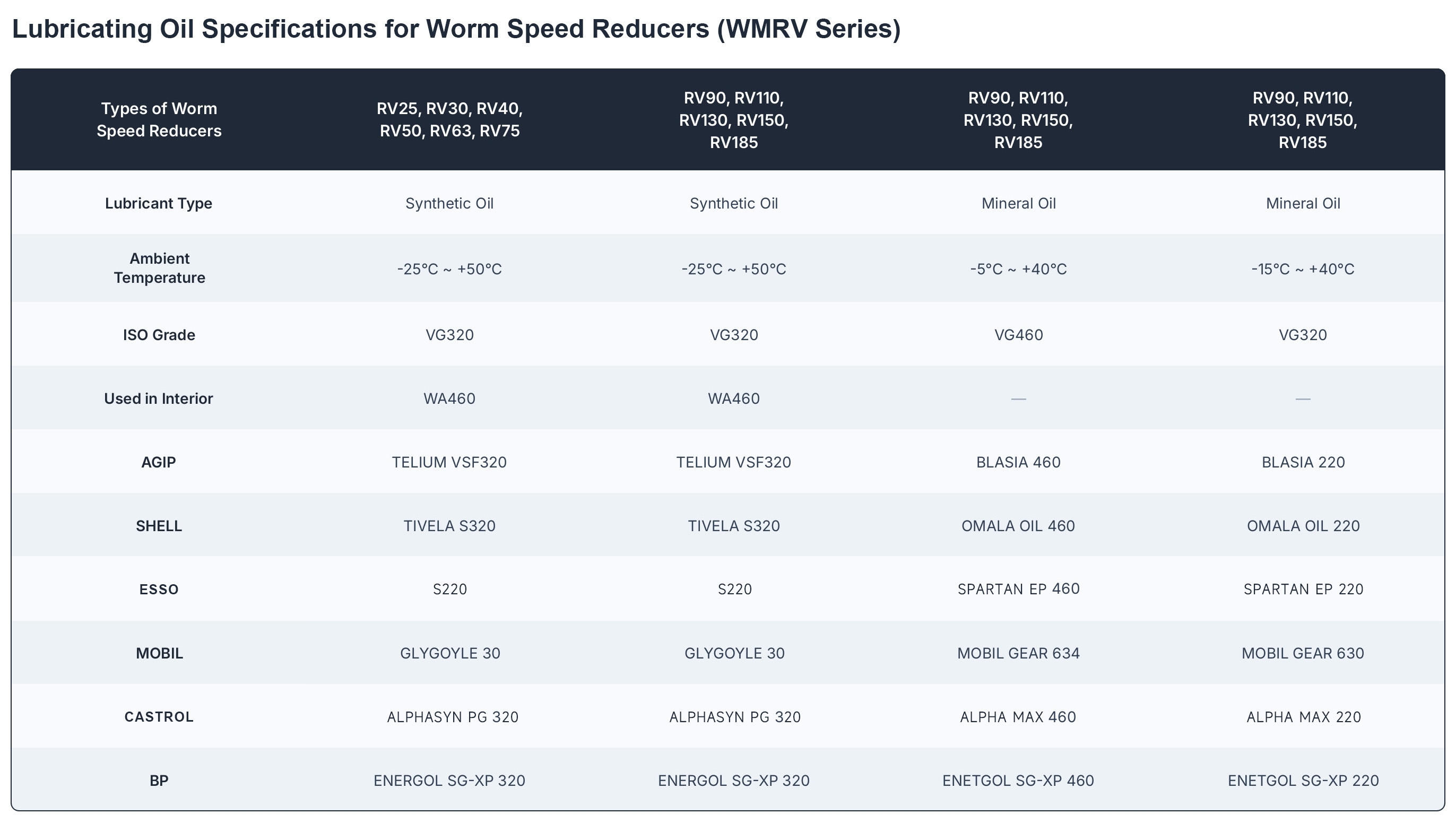
The tables below list lubricants that meet the performance standards for each gear type. Selection should always be based on viscosity grade and classification — the brand is secondary.
Worm Gear Oil Recommendations (CKE, VG220 / VG320)
Gear Oil Recommendations (CKC / CKD, VG150–VG320)
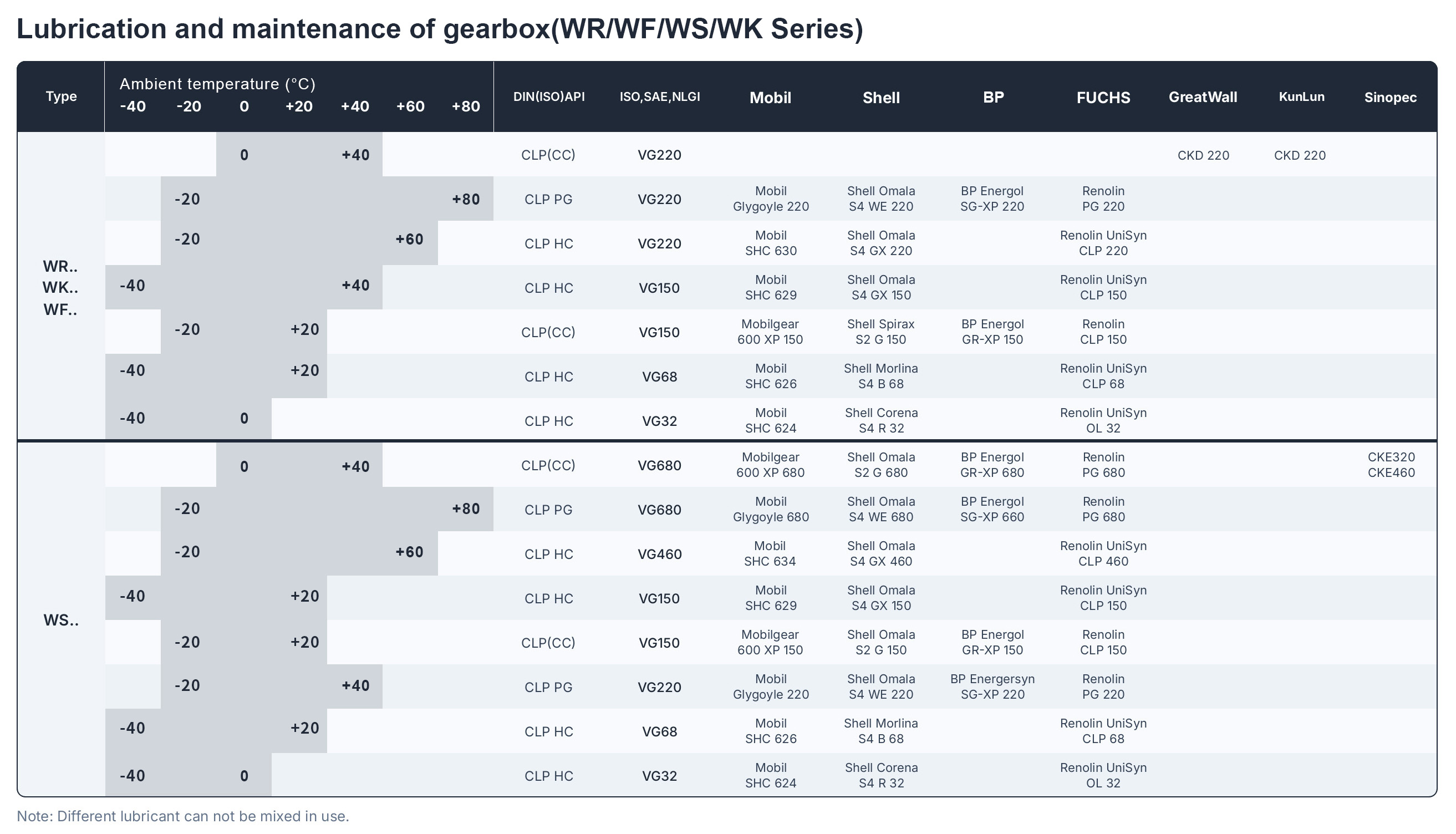
Note: Lubricant brand selection should be based on matching viscosity grade and classification. Domestic and imported oils at the same grade and classification are interchangeable — flush the system before switching brands.
5. Three Common Questions from Buyers
Q1: Can I switch to a cheaper oil brand?
Yes — if the replacement meets the same viscosity grade (e.g. VG220) and classification (e.g. CKC or CKE). Always flush residual oil before filling. Do not mix brands or grades.
Q2: Can I upgrade to a higher-performance oil?
Yes — moving from mineral to synthetic oil of the same grade improves temperature range and service life. Verify compatibility with existing seals before switching.
Q3: Can I replace an imported brand with a domestic one?
Yes — if the domestic oil meets the same classification and viscosity grade. Many domestic industrial gear oils meet ISO and AGMA standards equivalent to leading imported brands. Verify the spec sheet before purchasing.
6. Oil Change Intervals
Improper oil change intervals — too long or no initial change — are a leading cause of early gearbox failure.
- • Initial change: After the first 200–500 operating hours. Run-in debris must be flushed.
- • Mineral oil: Every 2,000–3,000 hours or once per year, whichever comes first.
- • Synthetic oil: Every 5,000–10,000 hours. Check viscosity and color annually.
- • High-load or high-temperature: Shorten intervals by 30–50%.
Key fact: Correct lubrication — right oil, right amount, right interval — can extend gearbox service life by 1 to 5 times compared to improper lubrication, with no change to the gearbox itself.
FAQ
Should I use oil or grease in my gear reducer?
Use oil for high-speed, continuous-duty, or high-heat gearboxes. Use grease for low-speed, intermittent, vertically mounted, or open reducers. If pitch line speed exceeds 2.5 m/s, oil is required.
What viscosity grade should I use for a worm gearbox?
Most worm gearboxes use VG220 or VG320 synthetic worm gear oil (CKE classification). Use VG320 for low-speed, heavy-load, or high-ambient-temperature conditions. Always follow the nameplate specification.
Can I switch lubricant brands without changing the viscosity grade?
Yes — match viscosity grade (VG220 or VG320) and classification (CKC, CKD, or CKE). Flush the system before switching brands to avoid mixing.
What is the difference between CKC and CKD gear oil?
CKC is medium-load EP gear oil for standard enclosed gearboxes. CKD is heavy-duty EP gear oil for large, heavily loaded, or shock-prone gearboxes. Both are suitable for helical and bevel-helical types — check your gearbox manual for the required classification.
How often should gear reducer lubricant be changed?
Change mineral oil every 2,000–3,000 hours or annually. Synthetic oil every 5,000–10,000 hours. Always do an initial oil change after the first 200–500 hours to flush run-in debris.
Need lubricant recommendations for a specific Wuma Drive gearbox?
Ask a Technical Specialist → Browse Gearbox Series
 Hot News